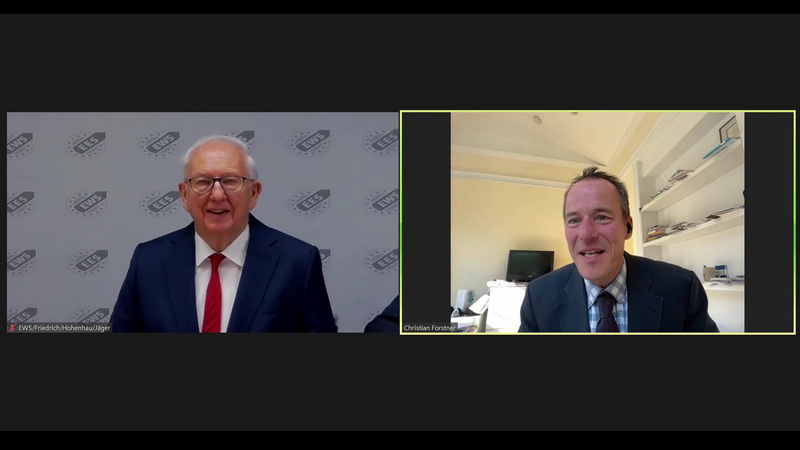
The Digital Senators’ Briefing organized by the European Economic Senate took place online via Zoom on 01/02/2022.
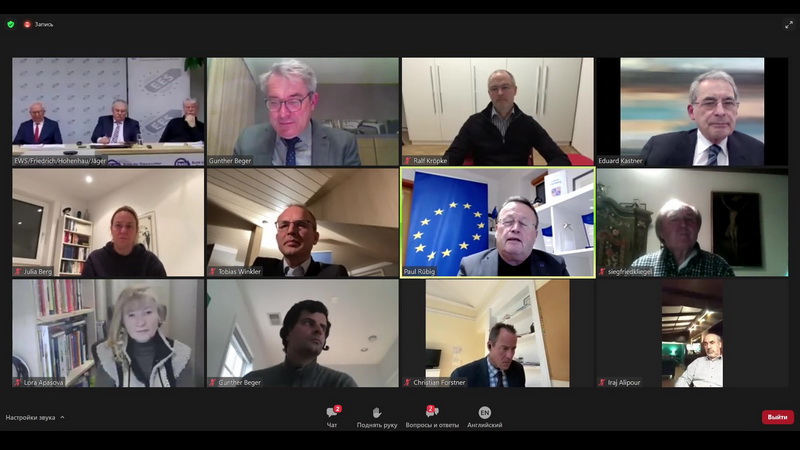
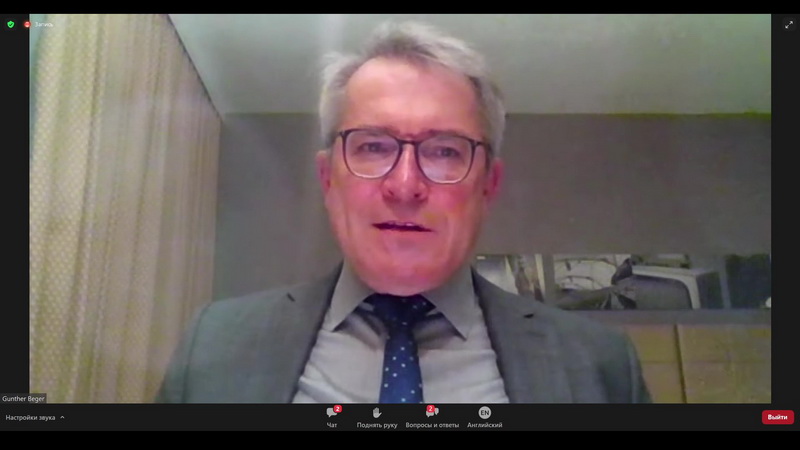
This Tuesday at 17:00 President of the European Economic Senate Ingo Friedrich, President of the Taxpayers Association of Europe Rolf Baron von Hohenhau, Secretary General of the Taxpayers Association of Europe, Chief Executive Manager of the European Economic Senate Michael Jaeger, chaired the online event. Mr. Gunther Beger the World Bank Group Executive Director representing Germany since March 2021, acted as a main speaker for the event.
After Mr. Ingo Friedrich’s introduction of Mr. Gunther Beger, Mr. Christian Forstner Director on the Board of The N.C. Zeitgeist Foundation addressed a welcoming speech for the rest of the participants.
Mr. Gunther Beger gave a speech that he divided into two parts. In the first part of his speech he dwelled upon a historical aspect of the creation of the World Bank Group. It was founded on 27 December 1946 following international ratification of the Bretton Woods agreements, which emerged from the United Nations Monetary and Financial Conference (1–22 July 1944). Commencing operations on 25 June 1946, it approved its first loan on 9 May 1947 (US$250M to France for postwar reconstruction, in real terms the largest loan the Bank has issued to date). He ended the first part of his speech by addressing the current state of the WBG and how it became what it is today, a family of five international organizations that make leveraged loans to developing countries. The end of the first part of his speech was dedicated to explaining the organization’s structure. The second part of his speech was dedicated to the consequences of covid-19 not only in the industrial but also in the developing countries. WBG study showed how many industrial countries returned to their previous levels of socio-economic growth, and many developing countries such as countries in Latin America couldn’t fully recover from the corona crisis. WBG not only heavily supported the supplying of the vaccines in the years 2019-2020 but also assisted such countries as Senegal in their production and overall stabilization of economic growth by eliminating different threats in the local economic sphere. Another painful topic is the rising levels of public debt in the developing countries (10%). With a debt moratorium ending in 2020, some countries such as Sudan, Ethiopia, Zambia and Chad had to be refinanced. A huge amount of piling debts creates a serious challenge to Germany who acts as the main creditor for those countries. Next topic presented by Mr. Beger would be WBG’s role in the climate sphere. In 2020 World Bank Group became the biggest climate sphere financier, offering 20 billion USD last year for climate projects, providing a “Climate Action Plan” and stimulating countries for green energy sector development. “One of the main sources of green energy that we considered financing is solar energy, but as we looked deeper into the production of solar panels we stumbled upon productions that presumably use slave labor. We had to ask ourselves a question “What is more important? Climate or human rights?” and we made a decision in favor of climate. But the World Bank has agreed on to creation of a paper that would regulate the situation with human rights on these productions in the nearest future. To summarize the role of the WBG is essential for our partners- the developing countries in means of both economic development and advisory support, the World Banks is like a huge tanker, we have 190 countries that are all partners in this bank the largest is the US.”
Then followed 3 the questions from Mr. Friedrich.
Can the World Bank go bankrupt if developing countries take too many credits?
-“I don’t think that is possible because of our system for giving out credit depending on the size of the country, but with large countries like India going bankrupt there exists a possibility, but even with that there exists a paper that states that “if a country goes bankrupt, the World Bank is the first receiver of money.” ”
If the average debt of countries if 263% does that mean that we have inflation tendencies worldwide?
“Yes, I think this is a problem, with the interest rates rising. Even with the programs that support individual economies, there of course is a danger of inflation”
What is your response on rebellions and revolutions of developing countries due to them being strangled by the debt from the World Bank?
“This is more of a question of appeasing. With my personal experience in Tunisia, I think that it is important for the world Bank creates a proper type of interaction with the debtor countries to prevent these things from happening.”
Then followed a question from Head of The Delegation of The European Parliament Mr. Tobias Winkler.
Does the World Bank plan to finance development of renewable types of energy different from solar energy such as wind energy and hydrogen energy?
“Thank you Mr. Winkler. In the nearest future we plan to move those countries from usage of coal to more eco-friendly types of energy, we plan to do that by financing development of only the renewable kinds of energy. Example would be how we encourage the north African countries to install solar panels and make it their primary source of energy. On topic of hydrogen energy, we have already invested in Morocco’s first industrial hydrogen production, it’s a huge project with a sum of investment of 57 billion euros. ”
Eduard Kastner, CEO of Kastner AG asked if WBG has plans for greening of the desert fs one of their potential environmental plans. MEP Mr. Paul Rubig also asked if WBG has any plans for providing the developing countries investments into sanitary installations, water purification and food supplying. Final question was voiced by Mr. Michael Jaeger about rising interest rates and if WBG has a strategy that would resolve the situation.
“The problems are described correctly, greening of the desert, pure water and food, sanitary installations. The WBG does play a role in all that but it is really not as significant as you think. What can really become a solution is when one tries to acquire private capital. The world bank is overburdened on that regard. And concerning the rising interest rates, I do not think I can give you a prognosis.”
Mr. Friedrich ended the event with a call to unite efforts on the worldwide level to help resolve issues of developing countries, due to the fact that big organizations like WBG can also get overburdened and miss important issues. «By increasing economic capacity of the developing countries we bring peace and stability to the world.»